
How to DCA Into US Stocks With USDT (and Earn on the Cash Waiting to Be Invested)
There are two common ways to dollar-cost average into US stocks with USDT: a recurring buy of one stock token on an exchange, or a recurring investment plan at a brokerage. CRE8 does it differently. You deposit the full amount into a portfolio up front, it buys in installments (daily, weekly, every two weeks or monthly), and the USDT still waiting to be invested sits in a USDT vault earning interest, withdrawable any time. For a single stock, an exchange recurring buy is enough. For a whole basket where you don't want the waiting cash to sit idle, CRE8's approach fits better.
What is dollar-cost averaging (DCA)?
Dollar-cost averaging means splitting a sum into equal parts and buying the same asset on a fixed schedule. Instead of putting 1,000 USDT in at once, you buy 100 USDT a week for 10 weeks.
The point is that you don't have to pick an entry price. The same amount buys fewer shares when prices are high and more when they're low. DCA spreads out the risk of buying at a bad moment. It doesn't guarantee a profit, and if the asset keeps falling, a DCA plan loses money too.
There are two ways to fund a DCA plan. One pulls each installment from your balance, and where the rest of your money sits in the meantime is up to you. The other takes the full amount up front and draws one installment at a time. CRE8 uses the second.
Can you DCA into stock tokens on Binance?
According to press reports, yes. Traders Union and Blockchain Reporter report that Binance's Convert and Buy Crypto features let you set up recurring buys of bStock, one stock per plan. We couldn't find an official Binance terms page, so check the frequency, minimum and fees in the Binance app.
bStock is a tokenized US stock on BNB Chain issued by BTech Holdings, a Binance affiliate. Each token is backed 1:1 by shares held with a custodian, and its price tracks the underlying stock. Binance states that bStocks are not shares, and dividends arrive as extra tokens after a 30% US withholding tax (Binance Learn).
A Binance recurring buy is simple and familiar, and Binance spot trading runs 24/7. If you want to DCA into several stocks, though, you set up one plan per stock and keep the proportions in line yourself.
How does DCA work at a brokerage?
A broker's recurring investment plan buys real shares, but you need an account funded in fiat. moomoo Australia, for example, offers recurring investments from $10, limited to selected stocks and ETFs (moomoo AU).
If all you hold is USDT, funding is the first hurdle. Interactive Brokers accepts stablecoin deposits, but only USDC, PYUSD and RLUSD, not USDT (IBKR FAQ). Investors in mainland China have been limited to selling and withdrawing at offshore brokers since May 22, 2026, with Futu and Tiger applying the rule from June 12 (CSRC, The Paper).
What does CRE8's DCA do differently?
CRE8's DCA takes one deposit, buys in installments, and keeps the uninvested part earning in a USDT vault.
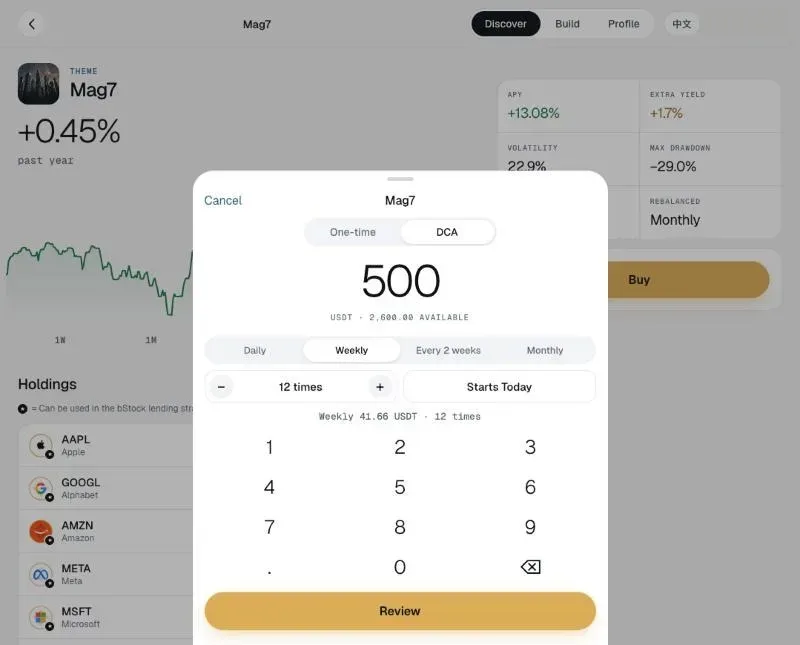
Here's how it works. You pick a portfolio, deposit the full amount of USDT into that portfolio's account, and set the number of installments and the frequency: daily, weekly, every two weeks or monthly. Each installment has to be at least 10 USDT.
On each installment date, the system takes one share of the money and buys every asset in the portfolio at its target weight. The rest waits in a USDT vault at market rates; CRE8 doesn't promise a rate. You can withdraw the uninvested part whenever you like.
Compared with an exchange recurring buy, that's two differences. Each installment buys a whole basket, so there's no need for one plan per stock. And the money waiting to be invested earns interest instead of sitting still.
The DCA money belongs to that portfolio only. It doesn't count as your cash and never mixes with another portfolio. What you buy goes into your own smart account, an account on BNB Chain that belongs to you, where CRE8's automation can only trade and moving anything out takes your signature.
CRE8 is on BNB Chain testnet only. Test USDT is free, no real money is involved, and there's no mainnet date yet.
What does a 1,000 USDT plan look like?
Say you pick the Pelosi Portfolio, deposit 1,000 USDT, and choose 10 weekly installments. Each week buys 100 USDT split by the portfolio's weights:
| Stock | Weight | Each installment | After 10 installments |
|---|---|---|---|
| NVIDIA (NVDA) | 19% | 19 USDT | 190 USDT |
| Alphabet (GOOGL) | 19% | 19 USDT | 190 USDT |
| Microsoft (MSFT) | 19% | 19 USDT | 190 USDT |
| Amazon (AMZN) | 19% | 19 USDT | 190 USDT |
| Intel (INTC) | 19% | 19 USDT | 190 USDT |
| Broadcom (AVGO) | 5% | 5 USDT | 50 USDT |
Weights are as shown on the Pelosi Portfolio page on November 23, 2026.
Now the waiting cash. After the first installment, 900 USDT is left in the vault; after the second, 800; after the tenth, nothing. Over the 10 weeks, an average of 450 USDT sits in the vault.
To show how the interest adds up, take a hypothetical rate. If the vault paid 4% a year, those 10 weeks would earn about 450 × 4% × 10 ÷ 52 ≈ 3.5 USDT. The 4% is only there to show the math. It isn't CRE8's rate; real rates follow the market, and testnet rates are simulated.
If you need the money partway through, you can withdraw the part that hasn't been invested. What's already been bought stays in the portfolio, and you can sell it back to USDT while the US market is open.
One more detail: stock tokens only trade during US market hours. If an installment falls while the market is closed, the order waits for the next open.
How should you pick the frequency and number of installments?
Start with the 10 USDT minimum per installment. The total divided by the number of installments gives the size of each one, so 1,000 USDT can be split into at most 100 installments, and 500 USDT into at most 50.
Then decide how long you want buying to take. The same 1,000 USDT in 10 installments takes about two weeks if daily and close to a year if monthly. The longer the plan, the more spread out your entry prices, and the longer the waiting cash sits in the vault.
With a daily plan, watch for market closures. US stocks don't trade on weekends or US holidays, so installments that fall on those days wait for the next open and end up executing together.
No frequency is better by default. How long you won't need the money, and how long you're willing to take to get fully invested, are the practical questions.
How do the three DCA options compare?
| Binance recurring buy | Brokerage recurring plan | CRE8 DCA (testnet) | |
|---|---|---|---|
| What you buy | bStock (stock tokens) | Real shares | A portfolio of bStock and crypto |
| Stocks per plan | One (per press reports) | Depends on the broker | A whole basket at target weights |
| Pay with USDT | Yes | Usually no; fiat first | Yes |
| Money not yet invested | Stays in your account, up to you | Stays in your brokerage account | Earns in a USDT vault, withdrawable any time |
| Frequency | Check the Binance app | Depends on the broker | Daily, weekly, every two weeks, monthly |
| Minimum per installment | Check the Binance app | From $10 at moomoo Australia | 10 USDT |
| Where assets sit | Exchange account, withdrawable | Brokerage account | Your own smart account |
| Status | Live (per press reports) | Live | BNB Chain testnet, no real money |
Data checked November 23, 2026. The Binance column comes from press reports, not official terms.
When is another option the better fit?
If you're buying a single stock, say 50 USDT of NVIDIA every week, a Binance recurring buy is the simplest setup.
If your money already sits in an exchange savings product and you don't mind where the waiting cash lives, an exchange recurring buy does the job.
If you want real shares with full shareholder rights, or a stock that isn't available as bStock, use a brokerage plan, provided you can open an account and fund it in fiat.
What are the risks?
DCA doesn't guarantee a profit. It spreads purchases over time, and if the asset falls over the long run, you still lose money.
bStock is not a share. You hold the issuer's certificate, and your rights depend on the issuer and the custodian.
Vault rates change and can drop close to zero. The vault is a smart contract too, and smart contracts can have bugs.
Portfolios go down as well as up. The Pelosi Portfolio's model APY (backtest) is +24.8% as of November 22, 2026, while its 30-day model return on the same page is −21.2%. Model APY runs today's weights through historical prices; it is not a track record.
CRE8 runs on smart contracts. The contracts get an external audit before mainnet.
FAQ
What's the minimum per installment on CRE8? 10 USDT. You can choose daily, weekly, every two weeks or monthly.
Can I get back the money that hasn't been invested yet? Yes. The uninvested part sits in a USDT vault and can be withdrawn any time.
Does DCA money mix with my cash? No. Your cash, each portfolio's money and any USDT a yield strategy borrows are kept separate. DCA money belongs to its portfolio only.
Lump sum or DCA? There's no single answer. A lump sum is fully invested right away; DCA spreads out the timing. It comes down to whether you're comfortable buying everything at one price.
Are there fees? Testnet is free, and CRE8 pays the gas. Mainnet fees will be announced before launch.
Next step
To see how waiting cash and the bStock in a portfolio can earn, read How to earn yield on idle USDT.
Further reading: Ways to buy US stocks with USDT, How CRE8 works.
Sources (checked November 23, 2026): Traders Union, Blockchain Reporter, Binance Learn: bStocks, moomoo AU recurring investment, IBKR stablecoin deposits, China Securities Regulatory Commission, The Paper, CRE8 Pelosi Portfolio, How CRE8 works.
This article is not investment advice.